AI Recommendation Patterns:
Mindful Drinking
Ally Kiel · AI Discoverability Strategy for Premium F&B Brands · March 2026
Key Findings
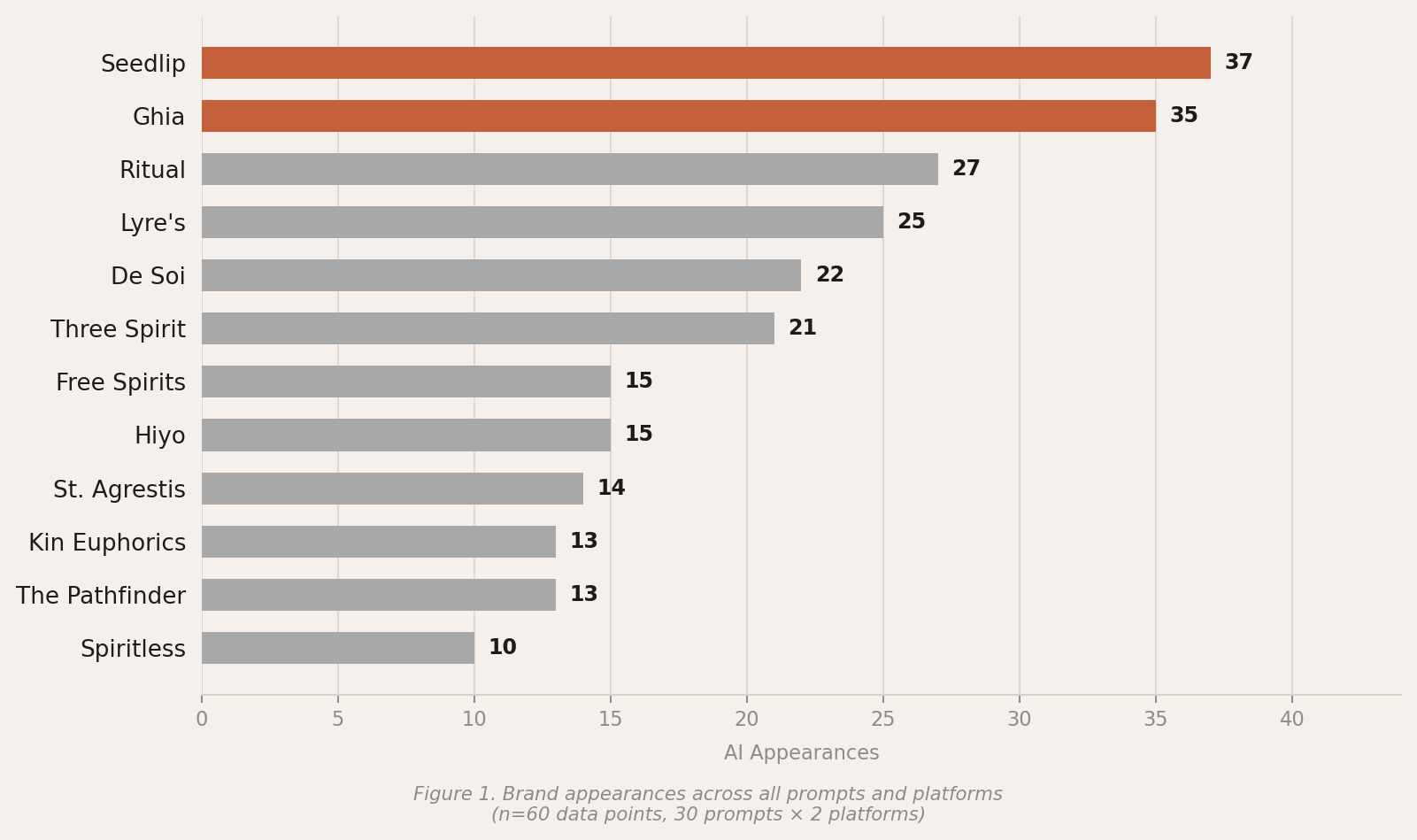
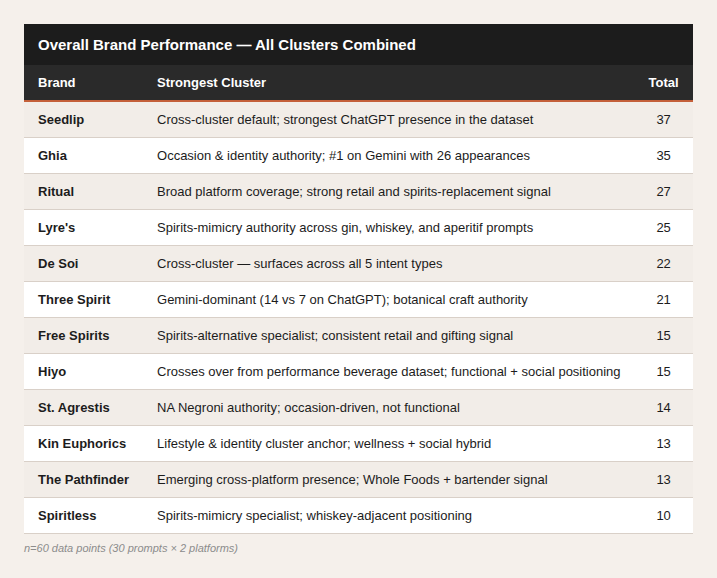
• Ghia and Seedlip are the co-dominant defaults — 35 and 37 appearances across 60 data points
• Ritual (27) and Lyre's (25) form a clear second tier; De Soi (22) and Three Spirit (21) close behind
• Ghia leads on Gemini with 26 appearances; Seedlip leads on ChatGPT with 20
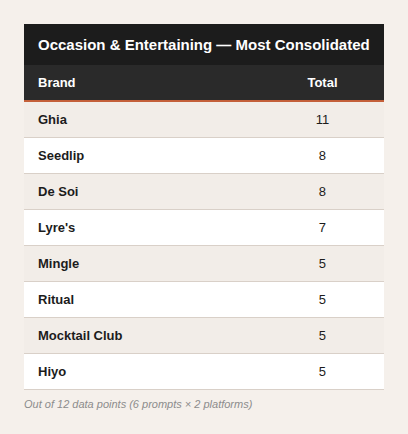
• Occasion & Entertaining is the most consolidated cluster — Ghia appears in 11 of 12 data points
• Lifestyle & Identity is the most differentiated cluster — largest open opportunity for challengers
Context
The Recommendation Layer
AI discovery tools are increasingly answering product questions directly instead of returning search results. When consumers ask questions like "best non-alcoholic aperitifs" or "best spirits for a sober-curious lifestyle," AI tools return condensed recommendation sets — typically 3 to 6 brands — rather than lists of websites. This creates a new competitive dynamic: brands must not only exist in the category — they must be included in AI-generated answers. For mindful drinking founders, the question is no longer only "can consumers find us?" but "does AI recommend us?"
Why Mindful Drinking Is a Different Research Challenge
Unlike olive oil or performance beverages — categories defined by product type — mindful drinking is a consumer behavior. It describes a posture toward alcohol, not a shelf set. That distinction matters for this research in two important ways. First, AI systems respond to mindful drinking prompts by drawing from a much wider product universe: non-alcoholic spirits, RTD aperitifs, botanical beverages, low-ABV sparkling drinks, and functional tonics all surface in response to the same intent. Some category bleed — beer, wine, soda — is structural and difficult to suppress at the prompt level alone. Second, the brands with the strongest AI presence in this category have often built it through cultural and identity-based positioning — cocktail culture, food media, wellness editorial — rather than functional benefit claims alone. Occasion and identity drive recommendation inclusion here in a way that is distinct from ingredient-forward categories.
How Recommendation Clusters Form
Large language models generate responses by synthesizing patterns learned from massive datasets — brand mentions across articles, buying guides, editorial recommendations, product comparisons, and structured product data. Over time, models learn that certain brands frequently appear in similar contexts, producing stable semantic brand clusters. Once a cluster forms, it tends to reinforce itself. Brands outside the cluster may appear inconsistently or not at all — a phenomenon that can be described as recommendation gravity.
Research Scope
Platforms tested: ChatGPT, Google Gemini
Total prompts: 30 prompts across 5 intent clusters
Total data points: 60 (30 prompts × 2 platforms)
Prompt approach: Purchase-intent, occasion, identity, and craft-driven queries
Clusters tested: Health & Mindful Drinking · Occasion & Entertaining · Taste & Craft · Lifestyle & Identity · Retail & Discovery
Overall Findings
Default Brand Formation
Across 60 data points, a small group of brands appears with striking consistency. The drop-off after the top five is steep — confirming that AI recommendation clusters are already consolidating around a small set of defaults, even in a category as behaviorally diffuse as mindful drinking.
Hello, World!
Cluster Analysis
How the Category Splits by Intent
Mindful drinking prompts do not return a single consistent brand set. AI systems respond differently depending on the consumer's intent. Five clusters reveal meaningfully different competitive landscapes.
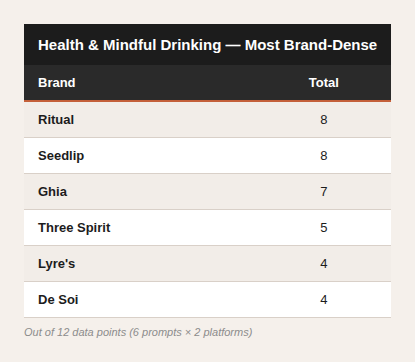
Health & Mindful Drinking — Most Brand-Dense
The broadest cluster in the dataset, returning the highest average brand count per prompt. Ritual and Seedlip anchor the set across both platforms. This cluster also produced the most category bleed — Athletic Brewing, Heineken, and OLIPOP surfaced in ChatGPT responses despite prompts being tightened to spirits and aperitifs. This is a structural finding: AI systems trained on wellness content have absorbed beer and soda as legitimate "mindful" alternatives.
Occasion & Entertaining — Most Consolidated
The most consolidated cluster in the dataset. Ghia's 11 appearances across 12 data points confirm what the performance beverage research first suggested: Ghia has built its AI presence almost entirely through occasion-based and cultural identity positioning — dinner party, date night, hosting — not functional benefit claims. Mocktail Club and Mingle show up as strong RTD occasion defaults on ChatGPT but are largely absent on Gemini.
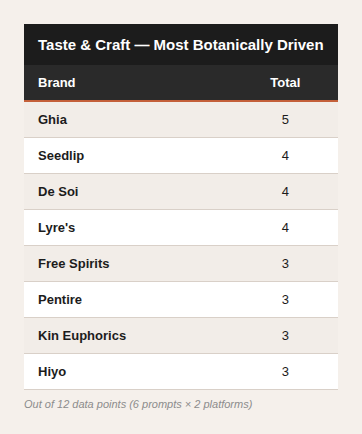
Taste & Craft — Most Botanically Driven
The cluster where ingredient and flavor positioning most directly drives recommendation inclusion. Seedlip's presence here is expected — years of botanical editorial coverage. Pentire's 3 appearances reflect strong coastal-botanical identity. Figlia shows meaningful presence — its flavor-forward, artist-collaborator positioning is legible to AI in a craft context. This cluster produced the most single-appearance brands, indicating it is the least consolidated and therefore carries the most open space.
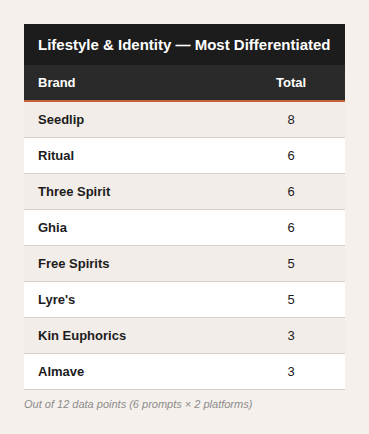
Lifestyle & Identity — Most Differentiated
The most strategically significant cluster for emerging NA brands. Identity-driven prompts — sober but still want something special, pregnant, athlete, wellness retreat — return the most varied competitive sets in the dataset. Seedlip anchors the cluster across both platforms. Kin Euphorics shows its highest relative concentration here, reflecting years of identity-forward brand building. Three Spirit and The Pathfinder both surface meaningfully. This cluster has the most open space for challenger brands with sharp identity positioning.
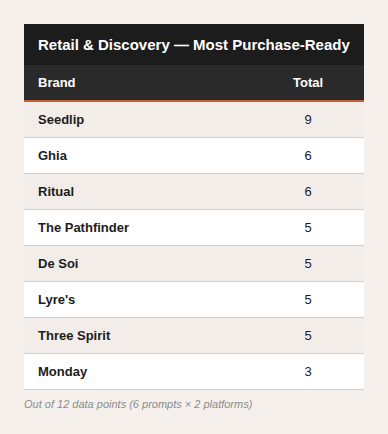
Retail & Discovery — Most Purchase-Ready
Purchase-intent prompts — Whole Foods, online, gifting, specialty grocery — return a notably strong showing for Seedlip and Ghia. Ritual's 6 appearances reflect consistent retail metadata and e-commerce signal. The Pathfinder and De Soi both surface strongly. Monday's 3 appearances are concentrated entirely in this cluster — its signal lives in online retail and gifting contexts rather than occasion or identity prompts, suggesting its discovery pathway is purchase-driven rather than culturally driven.
Emerging Brands
Brands Building Traction
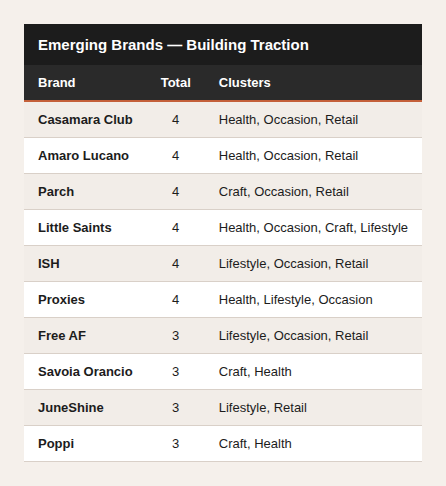
Below the established defaults, a second tier of brands appears 3 to 4 times across the dataset — not yet consistent enough to hold a default position, but appearing with enough regularity to signal that recommendation gravity is beginning to form. Three distinct sub-groups emerge based on where these brands are gaining traction:
Occasion & Aperitif Authority
Casamara Club (4), Amaro Lucano (4), and Parch (4) all surface most consistently in occasion and entertaining prompts. Casamara Club appears across Health, Occasion, and Retail, suggesting its botanical soda positioning is being classified across multiple intent contexts. Amaro Lucano surfaces on Gemini specifically in dinner party and aperitif prompts, indicating strong European aperitivo authority within Gemini's content index. Parch appears in Craft and Retail in addition to Occasion — a more distributed signal pattern.
Lifestyle & Identity Entrants
Little Saints (4), ISH (4), Proxies (4), and Free AF (3) are all gaining signal in identity-driven contexts — the cluster with the most open space in the dataset. Little Saints is the most broadly distributed, appearing across Health, Occasion, Craft, and Lifestyle. Proxies — Acid League's wine alternative line — appears across Health, Occasion, and Lifestyle, suggesting its wine-adjacent positioning is being classified as a mindful drinking option rather than purely a wine substitute.
Wellness Crossover
JuneShine (3), Savoia Orancio (3), and Poppi (3) represent the wellness crossover signal — brands not primarily positioned as NA or mindful drinking that are nonetheless being surfaced in health and craft prompts. JuneShine's kombucha-based seltzers appear in Lifestyle and Retail on Gemini. Savoia Orancio appears in Craft and Health — an Italian aperitivo being classified within the premium mindful drinking set.
Platform Divergence
ChatGPT vs. Gemini
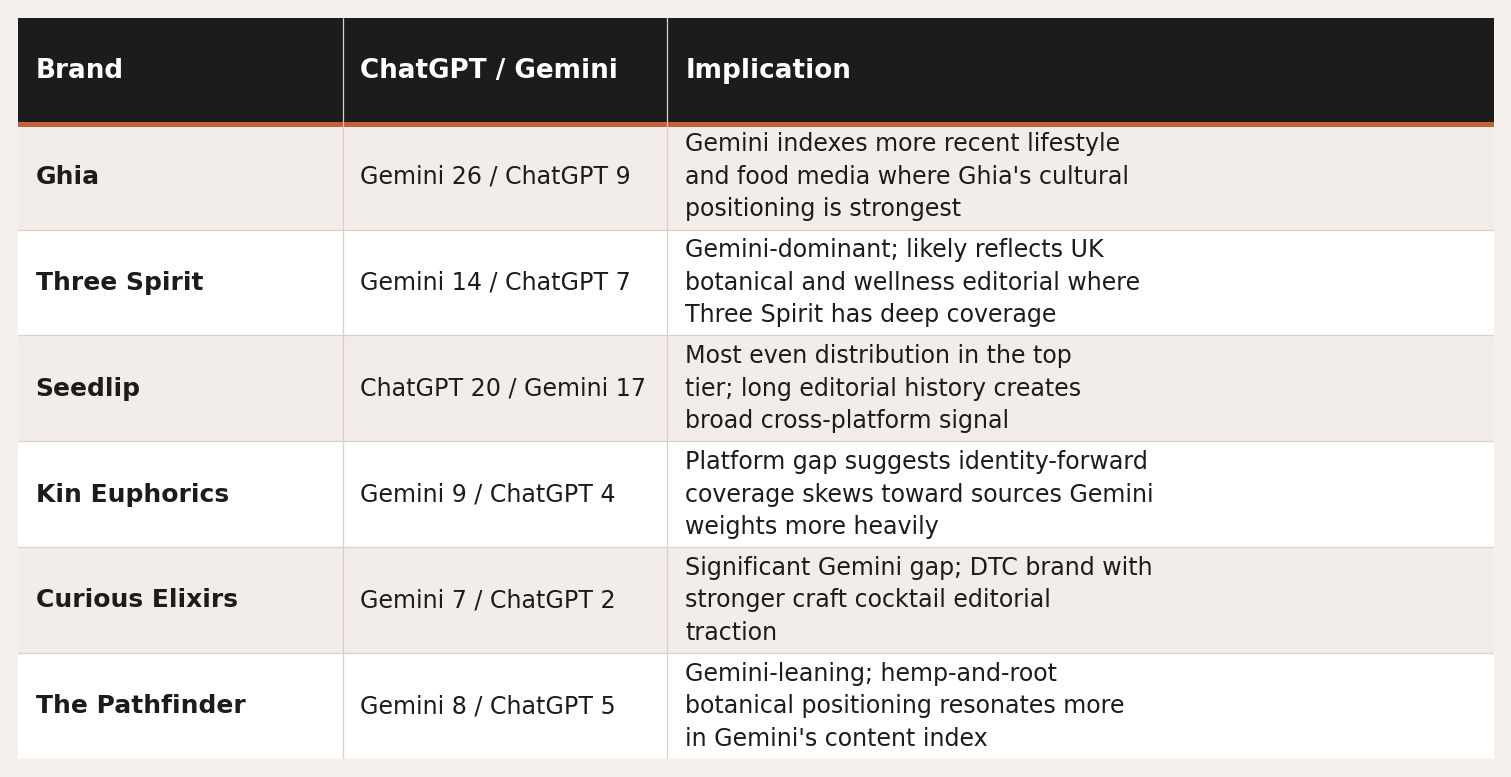
ChatGPT and Gemini do not return the same brand sets — in this category, the divergence is more pronounced than in olive oil or performance beverages. For a category defined by lifestyle identity rather than product type, that divergence has direct strategic implications.
A brand appearing consistently on ChatGPT but not Gemini — or vice versa — has a diagnosable signal gap. In a behavior-defined category like mindful drinking, the sources each platform draws from reflect different cultural contexts: food media, wellness editorial, bartender culture, and sober living communities each index differently. Brands that want cross-platform visibility need to build signal across all of them.
Brand Positioning
Where Does Your Brand Stand?
Based on this research, mindful drinking brands currently fall into one of three positions.
-
Seedlip, Ghia, Ritual, Lyre's
Appears consistently across multiple prompt variations and both platforms. Strong cultural, occasion, or spirits-mimicry associations reinforced across editorial content, buying guides, and retail metadata. Their dominance reflects the volume and consistency of how they are described in the content AI systems learn from — not simply distribution or brand recognition.
-
De Soi, Three Spirit, Free Spirits, Hiyo, St. Agrestis, Kin Euphorics, The Pathfinder, Spiritless, Pentire, Curious Elixirs, Figlia
Appears in some recommendations but not reliably — surfacing on one platform and not the other, or only for certain prompt types. De Soi is notable: it appears across all five clusters but never dominates any — broad but shallow signal density. This position is the most addressable in the near term.
-
The majority of the category
Does not appear in AI-generated recommendations for category-relevant prompts. Invisibility is not a reflection of product quality — it signals that identity and occasion associations are not yet legible to AI systems at the volume and consistency required for inclusion. This position is diagnosable and addressable.
These positions are not permanent. Recommendation clusters in mindful drinking are still forming. The brands that move from inconsistent to default over the next 12 months will likely be those that intentionally align their identity and occasion positioning with how AI systems learn to classify them.
The Window Is Open — For Now
The mindful drinking category is in an early and consequential window. AI recommendation clusters are not yet fully calcified. A small number of brands have established default positions — but the majority of the category remains in flux. That creates a genuine opportunity for brands that understand how these systems form associations and act before the window closes.
The findings in this report point to a pattern specific to this category: cultural and identity-based positioning drives recommendation inclusion as powerfully as functional benefit claims — sometimes more so. Ghia's 35 appearances are not the result of functional messaging. They are the result of years of consistent, legible cultural positioning across food media, lifestyle editorial, and sommelier culture. That is a replicable strategy.
The corollary is also true: a brand with strong retail presence and genuine product quality but diffuse or inconsistent identity messaging may be entirely invisible in AI-generated discovery. This is because AI systems haven't yet absorbed a clear, consistent signal about what it stands for and who it's for.
What This Means Practically
Founders should be asking: when a consumer asks an AI assistant for a recommendation in our category, does our brand appear? If not — or only sometimes — the gap is diagnosable and addressable. The signals AI systems learn from are not abstract. They live in product descriptions, editorial coverage, occasion-forward and identity-forward content, and retail metadata. Brands that audit their current signal footprint and align it with how these systems classify the category will be better positioned as AI-assisted discovery continues to grow.